
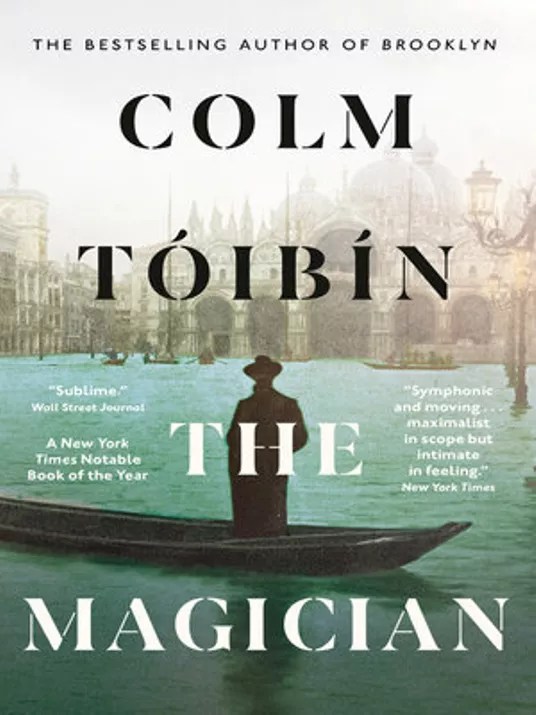
The magician is Thomas Mann, nicknamed by his children for his magic tricks. His magic also worked when, at the age of 25, he brought four generations of his family to life in The Buddenbrooks, or when he sublimated the mountain where he had gone to visit his wife, who was undergoing treatment at a sanatorium. He was however unable to thwart the chaotic or tragic destinies of his grown-up children. Irish author Colm Tóibín tells the story of this life entangled with Germany’s slow plunge into Nazi delirium at a suspenseful pace. On the other side of the coin, entire chapters are a pure accumulation of events often fabricated by the author, with long conversations and close-up descriptions of intimate situations.
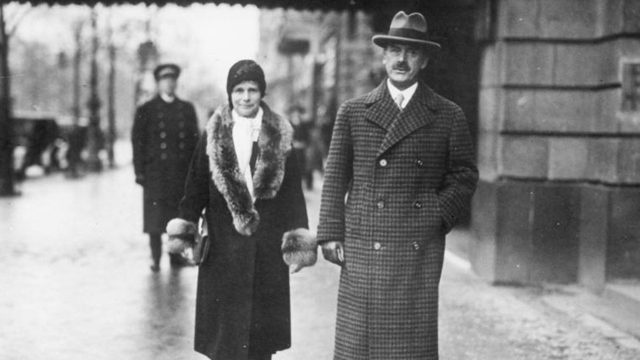
It is a novel then, but based on a wealth of research, as shown by the bibliography Tóibín appends at the end. We can trust him on the picture he paints of Germany at the dawn of the 20th century, and of Mann’s teenage years in Lübeck, which his Brazilian mother left after her husband’s death for Munich, where Mann began publishing and met the wealthy Katia Pringsheim. Trust him also on the thousand upsets of his exile in the United States, with the move to Princeton and then California, and contacts with the White House. And on the final ordeal, where Tóibín shows us how the writer kept his admiration for music intact right up to his last days, because of its power to achieve a purity impossible in literature, where you have to get your hands dirty. Tóibín closely traces this chronology of a life shaken by the thunderclaps of two world wars.
But above all, he paints a family portrait. For the bulk of the book focuses on Mann’s personal conflicts: confrontations with his six children, explosive sibling relationships, spats with each other at a time when politics was on everyone’s lips, rivalry with his brother Heinrich (the author of Professor Unrat, which became the famed Marlene Dietrich film The Blue Angel, and who was active at the other end of the political spectrum where Thomas was a conservative), anxiety at the time of forced emigration, pressure from all sides, in private, in public and behind the scenes. The toll of everything Mann went through is unheard-of. His two sisters committed suicide, and Heinrich, once famous, died destitute (long after Mann’s death, his youngest child, the violinist Michael Thomas Mann, also committed suicide). The book evokes his wife’s possible incestuous relations before they married, a theme taken up in the short story The Blood of the Walsungs, and the extravagant lives of his children, half of whom were ostentatiously gay or bisexual in a Germany on fire. For a time, the two eldest children, Erika and Klaus, shared lovers.
Sex occupies an important place in the book. We know that Mann himself has always been attracted to young boys. He never really hid his desires in private, let alone in his diary. But unlike André Gide, for example, he kept them secret in public all his life, with the complicity of his wife, so that their exposure when his diaries were published in 1975, twenty years after his death, had the impact of a revelation. Even if these desires do not seem to have been reciprocal, from Tóibín’s point of view they were the great business of his life.
There were classmates, and a dear friend in his twenties, or decades later love at first sight for a waiter in a grand Zurich hotel. Some characters in his works are inspired by these loves. In the opening paragraphs of Tonio Kröger, a friend he had loved at school becomes Hans Hansen, and “the fact was that Tonio loved Hans Hansen and had already suffered much for his sake.” In 1911, Mann was entranced by the beauty of a very young boy, whom he gazed at for hours on the Lido beach in Italy: the following year, the boy was reincarnated, cautiously aged by four years, as Tadzio in Death in Venice. A high school classmate appears as Hippe in The Magic Mountain, around the story of the borrowed pencil, and is fondly remembered by Hans Castorp bedridden in the sanatorium.
According to Tóibín, Mann didn’t just dream: he indulged his desires in real life. So The Magician includes erotic scenes, such as a mutual masturbation session with his teacher’s son one evening when Thomas was 17, or a few decades later an exchange of kisses in his office with a young admirer. Tóibín inserts these escapades into his narrative as facts among other facts. Of course they are possible if not verifiable, but it takes a certain amount of presumption to declare them likely, as he has done in various interviews. There is nothing in Mann’s known life to suggest he ever acted on it. “It’s not documented, admitted Tóibín in an interview with Le Monde, but the chances that he had no erotic encounters are close to zero.” “As a writer of fiction, he adds, I’m not at all concerned with erudition or accuracy. What interests me is forging an illusion for you, the reader. Sometimes, the less I know, the better.”
In the London Review of Books , Seamus Perry agreed with the German scholar Hermann Kurzke (whom Tóibín has read), that the negation of his sexuality, a moral failure for Mann, may have been a necessary precondition of his extraordinary work. Maybe his romanticism have led him to believe that the most precious experiences should avoid “the vulgar trap of something actually happening.” Perry quotes the sublime John Keats poem:
Heard melodies are sweet, but those unheard
Are sweeter; . . . .
Who’s right, who’s wrong? Tóibín cultivates the fruits of his imagination. One must not forget that he loads his narrative with a thousand raw details, as when he decides that Katia begins their first night of love by kissing Thomas “with her tongue, opening her mouth wide.” Hours before, throughout their meal in the restaurant, Tóibín imagines Mann picturing “Katia naked, her skin white, her lips full, her breasts small, her legs muscular. As she spoke to him in a low voice, he saw that she might as well be a boy.” Remember: it’s a novel, or a fictional biography.
It should be noted that, after his comrade Hans, Tonio Kröger will swoon over the blonde Ingeborg, who represents the unattainable joie de vivre for the writer in him. And Hans Castorp will court the eccentric and seductive Clawdia Chauchat, a relationship that reaches its climax during the wild “Walpurgis Night,” one of the highlights of The Magic Mountain, when Mann masterfully takes up the story of the borrowed pencil. The symbolism of the pencil is a little heavy-handed, but even if we foolishly reduce the character of Hans Castorp to the person of Thomas Mann, all avenues of interpretation remain open; in any case, that’s not the point.
Tóibín’s imagination is running wild about many other things that have nothing to do with sex. Whether or not you’re on the same wavelength as him may vary. Sometimes, even when we have understood that he is making it up, the kind of narrative demonstration he develops to illustrate his point of view can win us over. Thomas Mann was the target of serious accusations. When his son Klaus committed suicide in 1949, at the age of 42, he decided to continue his lecture tour instead of attending the funeral. Proof, it has been said a thousand times, that this egocentric man, locked up in his work, was a monster of coldness even towards those closest to him. The long pages in which Tóibín imagines the animated discussions between family members in the hours following the announcement of the tragedy—and the obsessive reminder of Klaus in Thomas’s mind until the end of his life—suggest that grief, not indifference, would explain the parents’ gesture: neither felt able to walk through the streets of Cannes behind their son’s coffin, then see him lowered into the earth (only Michael went).
Another frequent accusation against Mann is that he was soft in the face of the rise of Nazism, as if at first he had been in denial about a reality that was staring Heinrich, Erika, Klaus and Golo in the face. It certainly took him a long time to see fascism coming and to publicly oppose it. But for a while he was convinced that, banished from the Reich, he would have no readers and, oh dizzyingly, would have written The Magic Mountain ten years earlier for nothing and nobody. He also feared that taking a stand against the regime would endanger the lives of his publisher and his Jewish in-laws back in Germany. Soon, however, he would become one of the most active anti-Nazi voices: fifty-five speeches on the BBC between October 1940 and May 1945, not to mention conferences in America and elsewhere. So much for the hard facts. After the war, the Cold War began. The novelist then unfolds, in his inventive manner to which we are now accustomed, the long tale of Mann’s resistance to American pressure not to go to East Germany in 1949, on the occasion of Goethe’s bicentenary. Tóibín lets us listen in on some tough conversations in which we see Mann hold his ground, first against The Washington Post‘s big boss, the powerful banker Eugene Meyer, commissioned by Roosevelt to convince him not to make the trip, then with a State Department official who will have the FBI hot on his trail all the way to the border.
His dilemma was terrible: either he would give up the trip and be seen as a puppet of the Americans in the eyes of the entire German literary class; or he would go through with it and show ingratitude towards those who had helped, saved and protected him and his family. He courageously chose ingratitude, and went to Weimar, a little naively, and later he blamed himself, but for him the German language united East and West Germany in a fundamental way. He paid the price. In the midst of McCarthyism—where it was not enough to be non-communist, you had to be openly anti-communist—he lost his connections with Americans close to the government, notably the Meyers (he had been showered with favors by Agnes Meyer), and soon felt like an intruder in the United States. A Berkeley hotel, woke before its time, canceled an event at which he was scheduled to speak. He returned to Europe in 1952, three years before his death, although he would miss California—but not to Deutschland, his homeland that he now feared and which Katia rejected completely. There, too, he would be an intruder who had taken it easy during the war. He himself is disgusted at a banquet in his honor in Munich, where he is forced “to shake fleshy hands that not long ago were sticky with blood.” Hence Zurich. These nerve-wracking pages are among Tóibín’s best.
They point however to a recurring problem in the book. We knew well that Thomas and Katia had not gone to their son’s funeral, or that Mann had crossed into East Germany. Such is also the case with the wacky yet distressing departure from Stockholm when war breaks out, in which Tóibín masterfully stretches out the complications: will the panic-stricken couple manage to leave the city and escape the Germans? Of course they will! We knew it. By deciding to operate in the gray area between novel and biography, Tóibín has created some major pitfalls. These thrilling pages, though well-handled, are a dead giveaway for readers who know about Thomas Mann’s life and will find it impossible to suspend their disbelief. Others will learn a great deal, but without realizing, with the daunting bibliography at the end, that much of it has occurred only in Colm Tóibín’s imagination.
*
It is not unpleasant to see Mann’s works take shape through real-world events. We can guess that the trip to Italy we are told about, or the visit to a sanatorium in Davos, are the material that will soon be used to write the novels we know. But in the end Mann’s works basically serve to move the narrative forward. Some have applauded Tóibín for trying to make us relive his life rather than delve into the inner workings of his creations. We see the novels being born, but we don’t enter them. And it’s too bad. Sexuality takes up so much space in Tóibín’s mind that we forget the rich symbolism of Mann’s works. Gustav Aschenbach’s demonic passion for beauty in Death in Venice cannot be reduced to the figure of a handsome teenager. We visit a sanatorium with Mann in 1912 in real life, but very little light is shed on the fascination with disease, the splintering of time or the discussions on the future of Europe in The Magic Mountain. Tóibín does not even come close to approaching Mann’s creative genius. It does not seem to interest him.
That explains why some of his great works are conspicuous by their absence. Of the book’s 600 pages, a single paragraph on Joseph and His Brothers, whose four volumes took Mann ten years of his life. Only the development of his last, unfinished work, Confessions of Felix Krull, the story of a “king of the dodge, the one who always pulled himself up by his bootstraps,” is really gripping. On the other hand, while Mann was very selective in his reading of Nietzsche and Schopenhauer, both philosophers spurred him on in his work and thinking. Not a word about them or about his numerous essays. Yet the cohabitation of a fertile creator and an intellectual caught up in the most violent upheavals of History—first apolitical in the pure Germanic tradition, then a supporter of the Weimar Republic and after the war a severe critic of Western culture—is fascinating. On the subject of literature itself, a short, one-page discussion with Heinrich. That said, Tóibín often shows him at work. After all, the creation of his works occupied him every day of his life, riveted as he was to his table every morning, nulla dies sine linea, even on the liner on which he fled Europe, with a corner set aside for him, much to the chagrin of the other passengers, numerous and crowded, who had no use for this favor granted to him. But Katia had seen to it.
The book paints a vivid portrait of her. Far from being in the shadows, Katia Pringsheim has a greater presence than her husband in the novel: brilliant, gifted with a wonderful sense of irony, discreet and influential, supportive of Thomas in everything, and making no bones about his more or less hidden homosexuality. At times, the whole couple remains mysterious. We don’t feel the abyss to which their children’s antics or the uncertainties created by their repeated moves from one continent to another must have dragged them. Meanwhile, far too much remains anecdotal. It is entertaining to meet Mann’s friend Albert Einstein (who flirts with Katia), Alma Mahler (flirts with Mann), Brecht, the old Bruno Walter (has an affair with Erika), Eleanor Roosevelt, and many others during the American exile—but it doesn’t shed any light on anything.
All that said, there is an indisputable pleasure in reading The Magician that comes both from the rich documentation on Mann from which Tóibín has drawn, and from his skilful dramatization of the ups and downs of his life, his encounters and confrontations of all kinds. The distance that the neutral style he has adopted enables him to maintain, neither praising nor condemning his protagonist, perhaps prevents him from really entering into Mann’s being and thinking, and this is why in the novel the writer is often aloof and silent, as if witnessing the story of his life. But at the same time, through this neutrality mingled with a certain sympathy, the profile of a very solid man emerges, who created works of uncommon richness from the age of seventeen until the last months of his life, in the midst of major upheavals. If Tóibín is not always convincing, he does have the merit of showing just how complex, even opaque, the great German writer’s personality was. And perhaps that’s just as well.
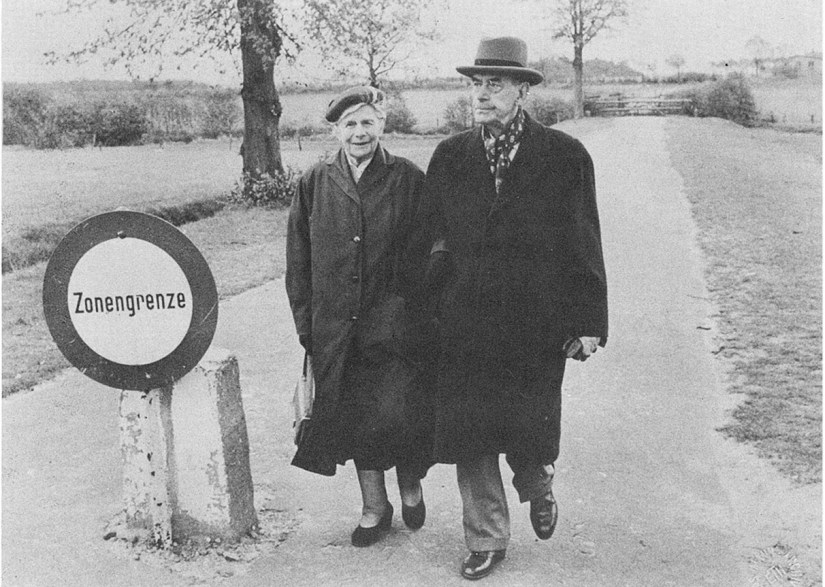
© 2013 Keystone / Thomas-Mann-Archiv Zürich
♠
 Jacques Desrosiers
 Quartiers littéraires