Note that the original French version of this article was published four years ago.
The End is the sixth and final volume of Knausgaard’s monumental novel cycle, My Struggle. Written at breakneck speed between winter 2008 and autumn 2011, the complete 3,700-page work chronicles forty years of the author’s life in seemingly chaotic detail. Despite the label of “automatic writing” sometimes attached to a narrative seemingly careless of style, though correctly written, the work exhibits a remarkable level of structure. This finesse reaches a peak in the second volume, A Man in Love, where Knausgaard weaves a complex tapestry of nested flashbacks—sometimes five or six layers deep, punctuated by still briefer temporal shifts—but from which we return each time to the precise moment when the narrative was interrupted. This cyclical construction can offer a challenging reading experience, as when Knausgaard serves champagne to his friends at a New Year’s Eve party at home, only to have the main course served two hundred pages later.
*
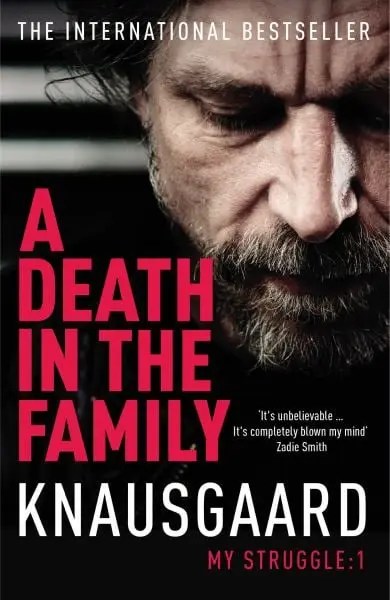
In A Death in the Family (Book 1), Knausgaard described the decline of his father, a stern man so execrable as to be pitiable, and his tragic death in 1998. The most compelling section of the book brought together the tense trio of the two sons and their alcoholic grandmother, who was becoming senile in her house, where the smell of excrement wafted over empty bottles scattered everywhere. The meticulous account of the house’s cleaning, which recreates the poignant atmosphere that reigns there, has become for many readers the symbol par excellence of Knausgaard’s style.
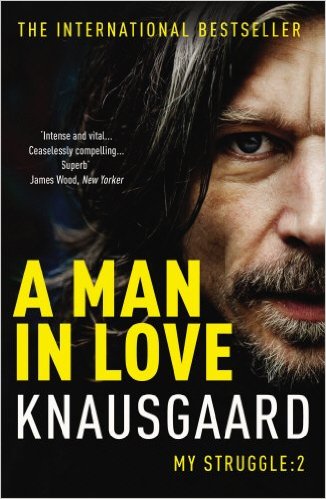
In 2002, in his mid-thirties, he divorced his wife and departed from the Norwegian town of Bergen to settle in Sweden. There, he falls madly in love with writer Linda Boström. This is the story of A Man in Love (Book 2): a tale of love at first sight, a second marriage, and the challenges of balancing writing with the responsibilities of raising three toddlers and managing household chores. The book starts with romance, but quickly delves into marital strife and the disillusionment of everyday life. Yet Knausgaard, the tireless essayist, doesn’t give up: death remains the focus of his reflections as he walks his children in a stroller through the streets, all the while reading Hölderlin and Dostoyevsky.
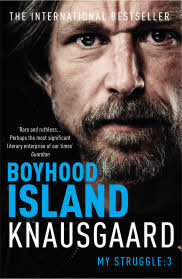
Boyhood Island (Book 3) exposes the oppressive grip his father held over him until the age of thirteen. By portraying the alternating joys and terrors of childhood, the story brings a young boy vividly to life, a feat achieved by few writers. This time, memories unfold in a linear sequence—games, school, vacations, friends, comics, bullying, flirting, porn magazines, soccer, and music—all overshadowed by the looming presence of his father’s treatment of him at home. This volume may well be the strongest in the series, offering a forty-year-old man’s poignant reflection on the child he once was. It echoes William Wordsworth’s famous line, “The child is the father of the man.”
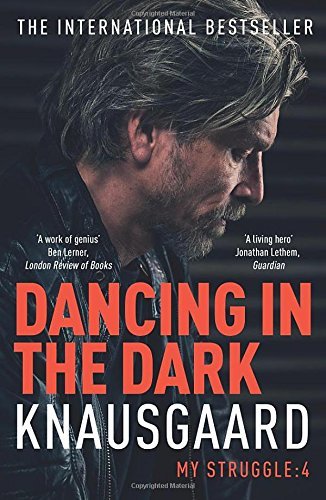
In Dancing in the Dark (Book 4), an eighteen-year-old Knausgaard, freshly graduated from high school, takes up a teaching post in a remote Arctic fishing village, seeking solitude to fuel his writing. Still a virgin after repeated failures, he finds himself unsettled by the striking beauty of his pupils, girls barely younger than himself. Yet each time a local girl responds to his advances, even the most innocent caress or glimpse of bare skin proves enough to overwhelm him with a shameful premature ejaculation. At the heart of the novel lies a long flashback to his last years of high school, marked by his parents’ divorce, binge drinking, and teenage love affairs. By the end of his teaching assignment, he finally loses his virginity—at a rock festival in Denmark, in the cramped intimacy of a tent.
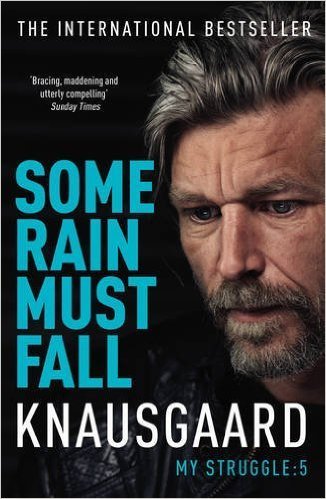
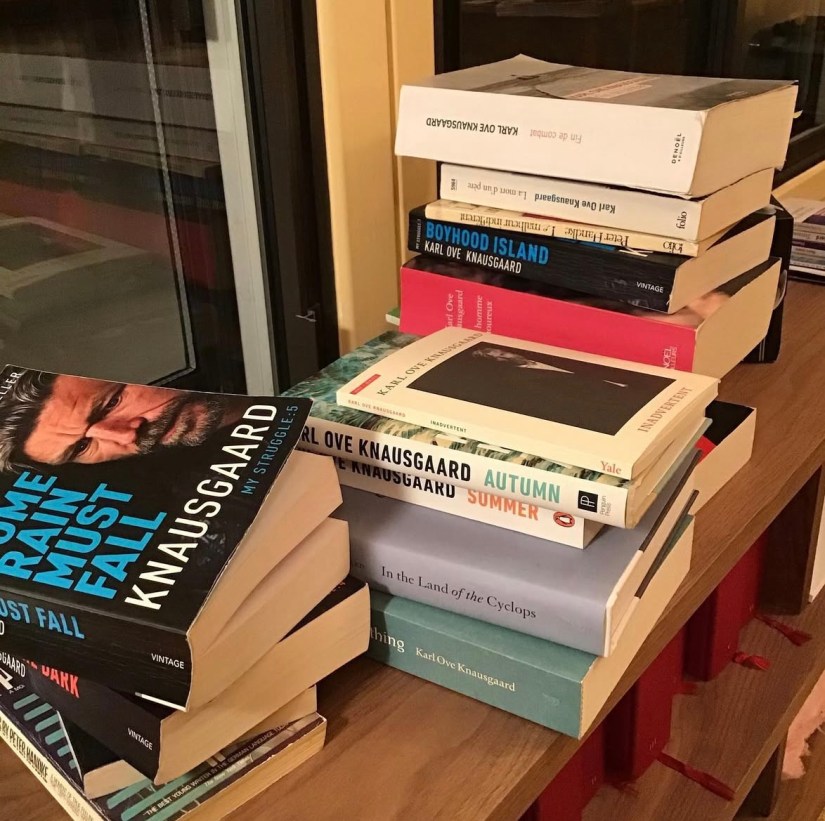
Some Rain Must Fall (Book 5)—seven hundred pages written in just eight weeks—finds him in Bergen the following year, the youngest participant in a writing academy. Humiliated by the class’s devastating comments on his texts, he skips meetings and sinks into drinking. A somewhat more mature, but no more likable Karl Ove navigates life as a student of literature and art history, working summers in psychiatric hospitals, then full-time at a radio station. He plays drums in bands, writes reviews, drifts through girlfriends and one-night stands, and drinks heavily, driven by a rage to write but convinced he has no talent. He eventually marries and completes his first novel in 1998, the same year his father dies, which brings us back to Book 1. His marriage ultimately falls apart due to his infidelity.
*
Then comes The End, published in 2011, recounting events from 2009. The release of A Death in the Family in Norway had sent shockwaves through Knausgaard’s life, sparking both public outrage and private turmoil. His uncle, enraged by the book’s revelations, threatened legal action to halt its publication, while the later appearance of A Man in Love pushed his wife to the brink of psychological collapse. Within two years, Knausgaard had become a literary sensation, and now found himself hiding from the world to finish the very book we hold in our hands. The result is a monumental, singular work of staggering ambition. Two vast narrative blocks—four hundred pages on the fallout from Book 1, and three hundred pages on the repercussions of the subsequent volumes and his wife’s deepening depression—frame a torrential four-hundred-page essay titled “The Name and the Number.” At its core lies a razor-sharp analysis of Hitler’s Mein Kampf (My Struggle)—a deliberate confrontation with the very title that echoes Knausgaard’s own series.

This volume focuses primarily on the consequences that publishing the preceding books had for those closest to him. Haunted by a lifelong sense of guilt, Knausgaard is more tormented than ever when confronted with the harm he has inflicted on his family through his public airing of private grievances: “This novel has hurt everyone around me, it has hurt me, and in a few years, when they are old enough to read it, it will hurt my children.” So profound is his anguish that, in the final line of The End, written one September morning, he vows to stop writing altogether. He had long dreamed of being a writer, “a beacon for others,” yet realized during his time at the Writing Academy that he was not. Now, after eight books, including the two novels written before My Struggle, he declares it all over. There is no reason to doubt his sincerity, though his decision proved short-lived, as he went on to publish several essays, the four-volume Seasons Quartet, and another novel.
*
If, unlike Jean-Jacques Rousseau in his Confessions, Karl Ove does not cast himself as a victim, shame nonetheless remains the big thing in his life. His father never missed an opportunity to belittle him:
When I arrived dad was at home. He was in the laundry room at the bottom of the house.
He turned to me, anger in every movement.
‘I picked you some flowers,’ I said.
He reached out with his hand, took them and threw them in the large sink.
‘Little girls pick flowers,’ he said. (Boyhood Island)
At school he was humiliated by his classmates; as a teenager, by girls; and even in his twenties, disagreements with friends could still bring him to tears.
We learn about his rages, his failures, and his impatience, as well as his most private thoughts (“My father is dead, and I am thinking about the money that will bring me. So what? I think what I think, can’t help thinking what I think, can I?”) and his character flaws (“Had I ever initiated a conversation with a stranger? No, never. And there was no evidence to suggest I ever would.”). He also confesses to minor transgressions, such as shoplifting with a friend from a grocery store run by two sweet old ladies. When the woman he loves rejects him, he slashes his own face with a piece of glass; and when they finally kiss for the first time, he faints (and requires medical attention).
Knausgaard never hedges his bets: his story is based on a pact of sincerity. He is no martyr, however, and even in his darkest moments there is always someone ready to help. There are victories, too. Reflecting on his mother, he writes:
She saved me because if she hadn’t been there I would have grown up alone with dad, and sooner or later I would have taken my life, one way or another. But she was there, dad’s darkness had a counterbalance, I am alive and the fact that I do not live my life to the full has nothing to do with the balance of my childhood. I am alive, I have my own children and with them I have tried to achieve only one aim: that they shouldn’t be afraid of their father.
They aren’t. I know that. (Boyhood Island)
Yet, the work is much more than an exorcism of personal problems. In fact, Knausgaard transforms his personal problems into a fertile source of literary inspiration. “The point of the book was not my life but what I made out of it in literature,” he explained in an interview with the WSJ Magazine in November 2015.
*
Because he deliberately avoids editing his writing, Knausgaard sometimes leaves thoughts unfinished, abruptly shifting to other topics. At times, this gives the narrative a disjointed feel. More often, however, he lingers and expands, preserving even the most trivial details. For instance, he dedicates over seventy pages to two teenagers’ clandestine trip to buy beer. In another instance, he reflects on an event with his mother on New Year’s Eve, twenty-five years later:
‘Could you iron my shirt while you’re at it?’ I asked.
She nodded.
‘Just put it on the ironing table.’ (A Death in the Family)
This is how he mentions his favorite brand of deodorant, describes the hand signal he uses to order from a waiter, or notes his mother’s driving position as she backs into the driveway. Are diaper changes part of his life? Diaper changes are part of the novel. His children—their personalities, daily routines, quarrels, and demands—are also a huge part of the work, without anything special ever happening to them, but simply because they are there. In the middle of an argument, he may suddenly pause to describe how the sausages are sizzling in the pan, or recite his bank card’s PIN number as he struggles to recall it. The essential and the trivial are in constant dialogue. Details of no apparent importance, yet never without interest:
The passing cars left tails of swirling snow behind them. A huge articulated lorry came down the hill with its chains clanking, it braked and just managed to judder to a halt before the zebra crossing as the lights changed to red. I always had a bad conscience whenever vehicles had to stop because of me, a kind of imbalance arose, I felt as though I owed them something. The bigger the vehicle, the worse the guilt. I tried to catch the driver’s eye as I crossed so that I could nod to restore the balance. But his eyes were following his hand, which he had raised to take something down from inside the cab, perhaps a map because the lorry was Polish. He didn’t see me, but that didn’t matter, in which case braking couldn’t have bothered him to any great extent. (A Death in the Family)
This minor event has no bearing whatsoever on the story. In other words, Knausgaard will point out Chekhov’s gun hanging on the wall, even though it will never be fired or serve a purpose. In a writing class, one would be advised to cut such elements in the name of streamlining the narrative. But Knausgaard ignores this convention, treating these moments not as mere digressions but as vital to the fabric of the book. Trivialities become essential: it is their accumulation that captivates readers, making us devour thousands of pages. The abundance of candid glances at everyday reality—his curiosity about everything from the mood of loved ones to the appearance of strangers, from the texture of the city to the nuances of the sky—reflects an extraordinary “presence in the world” throughout the novel.
*
The banalities that permeate the book serve several purposes. First, they generate the momentum that drives the story forward; without them, the story would risk reverting to the conventional, rigidly categorized fiction. Second, these mundane details offer a vital counterbalance to the emotionally charged scenes that arise out of ordinary life, creating striking realism. For Knausgaard, emotion is the essence of the novel—hence his admiration for Knut Hamsun and his indifference to Milan Kundera. These banalities also enable the exploration of the distant past, since every aspect of a life is interconnected, and thus keep the narrative machinery running smoothly. As Knausgaard put it in the WSJ Magazine interview: “The recall comes in the writing.”
Many readers grow impatient with the apparent digressions in My Struggle, frustrated by the absence of the story they expected. Yet, according to Knausgaard, the primary function of literature is precisely not to fulfill expectations. He expressed his dissatisfaction with conventional fiction in A Man in Love, in what is perhaps the most significant passage in these thousands of pages:
Just the thought of fiction, just the thought of a fabricated character in a fabricated plot made me feel nauseous . . . Wherever you turned you saw fiction. All these millions of paperbacks, hardbacks, DVDs and TV series, they were all about made-up people in a made-up, though realistic, world. And news in the press, TV news and radio news had exactly the same format, documentaries had the same format, they were also stories, and it made no difference whether what they told had actually happened or not. It was a crisis, I felt it in every fibre of my body, something saturating was spreading through my consciousness . . . because the nucleus of all this fiction, whether true or not, was verisimilitude and the distance it held to reality was constant.
In The End, he observes once more that when “everything is either fiction or seen as fiction, the job of the novelist can no longer be to write more fictions.” Some Rain Must Fall chronicles his painstaking attempts in his twenties to write traditional novels—he completed two—which ultimately led him to abandon invention altogether. His trajectory as a writer unfolds in three distinct phases: (1) the traditional novel, by its very nature, imposes a distance from lived experience; (2) to bridge this gap, Knausgaard dismantle conventional form, writing about himself with unfiltered honesty; (3) the result is a narrative flow rich in detail, unburdened by plot, convention, or even a fixed theme. As he explains in Inadvertent, his 2018 Yale lecture, “I didn’t want to write about the relationship between a father and a son, I wanted to write about Dad and me.” Knausgaard’s approach is to “combat fiction with fiction” (A Death in the Family). He chooses to tell his story in full, not because he finds it captivating, but because it offers the most direct path to reality—one stripped of the artifices of traditional storytelling. In a 2018 interview with The New Yorker, he describes how, through this process, his own self became “a kind of place where emotions, thoughts, and images passed through.” This, in essence, is the core of Knausgaard’s literary project.
*
That said, he did engage in some invention. In The End, he explains that, following the publication of the first two volumes, he was pressured—by his publisher, lawyers, and the public—to change names and make other alterations in subsequent volumes. And even though he possesses an extraordinary memory, he admits to filling in gaps to keep writing “without inventing.” Yet his meticulous recollections of distant childhood scenes, or his verbatim rendering of a conversation held three years earlier—spanning sixty pages—clearly involve the reconstruction of a “plausible” dialogue. The line between memory and imagination is thin. (Can one truly tell a story without inventing? See the joint interview with Maggie Nelson referenced at the end of this article.)
Good old-fashioned literary devices resurface as well, particularly when he evokes the weather. Consider this memory recalled from fifteen years earlier:
The trees outside the window were black, the darkness between them pale. It wasn’t raining any more, but the wind was still rising and falling in the forest like billowing breakers of the air. (Some Rain Must Fall)
Other literary recipes reappear occasionally, but their rarity makes them all the more conspicuous. If he were to invent too much, there would be no “struggle” and the work would collapse. Suspense, too, proves unavoidable: What will become of Linda? Knausgaard has been accused of putting words in the mouths of people who never actually uttered them. Yet here too, there is no reason to doubt that, in his innermost conviction, he spoke the truth and upheld his demand for honesty in everything he wrote about himself.
The meditation on death that opens A Death in the Family recalls the beginning of classic novels. This passage stands apart from the rest of the work, not only for its profound depth but also for its stylistic elegance. In crafting it, Knausgaard risked slipping into the conventions of the traditional novel, yet he refused to retreat. Instead, just a few pages later, he abruptly shifts tone:
Today is 27 February. The time is 11.43 p.m. I, Karl Ove Knausgaard, was born in December 1968, and at the time of writing I am thirty-nine years old. I have three children – Vanja, Heidi and John – and am in my second marriage, to Linda Boström Knausgaard. All four are asleep in the rooms around me, in an apartment in Malmö where we have lived for a year and a half. . . .
While elements of traditional literature occasionally surface in My Struggle, they do so at the margins, far from the main battlefield.
*
A parenthesis on Proust. Much has been made of the comparison between Proust and Knausgaard, particularly in the English-speaking world, where it is often celebrated. In France, however, some critics have dismissed Knausgaard’s work as poorly written and riddled with clichés, using the parallel with Proust less to praise than to undermine his reputation.
Needless to say, the style of My Struggle bears little resemblance to Proust’s extraordinary refinement of the sentence. Knausgaard eschews embellishment, offering instead what he presents as unvarnished truth. He rejects the principle of beauty in literature, or at least he challenges its conventional role. His idea, though, is not without purpose:
As a stylistic device in literature, a particular filter through which the world is viewed, beauty lends hope to the hopeless, worth to the worthless, meaning to the meaningless. This is inevitably so. Loneliness beautifully described raises the soul to great heights. But then the writing is no longer true because there is no beauty in loneliness, not even in yearning is there beauty. (The End)
To be sure, Karl Ove does not write with Marcel’s detached gaze. His guiding principle is to keep as little distance as possible. Only a handful of passages in the novel could genuinely be called Proustian: the pareidolia of a face glimpsed in the sea on television at the age of eight (recalled twice in A Death in the Family); the description of his grandmother’s death; and the poignant epilogue of Boyhood Island when, at thirteen, he leaves the landscape of his childhood. And that is about all.

But In Search of Lost Time is far more than a collection of finely wrought sentences. The legacy that Knausgaard inherits from Proust becomes clear when one considers the work as a whole: the vast undertaking that makes literature an ultimate quest; the ambition to bear witness to all that has been experienced; the images and digressions that unlock unsuspected doors; the action that never forgets reflection; and the pervasive nostalgia that runs through the work. All of these elements, as we have understood, are in part made possible by involuntary memory.
When Jean-Yves Tadié, widely regarded as the world’s foremost expert on Proust, observes that with Proust “we move, within a few sentences and at an astonishing speed, from the simplest event, a stumbling foot [on the cobblestones of the Hôtel de Guermantes], to the meaning of life, the world, time and art,” you would think he is talking about Knausgaard. The crucial distinction, though, lies in the aftermath: where Proust’s incident triggers an epiphany, in Knausgaard it merely joins the endless procession of banal moments that fill a day.
*
The essay “The Name and the Number,” positioned at the center of The End, is dazzling. Many readers have seen it as an unexpected hapax legomenon—a singular, almost anomalous text that seems to appear out of nowhere. Yet it is a hapax with precedents. The extermination of the Jews is briefly evoked in volumes 3, 4 and 5. As a child, Karl Ove encountered images of naked bodies in Nazi extermination camps during a school trip to the local library. Later, he came across unsettling traces of Nazism within his own family’s belongings. And looming in the background is the shadow of his compatriot, Knut Hamsun—Nobel laureate and open admirer of Hitler.
From the very first line, the narrative is punctuated by meditations that branch off in every direction. In each volume, Knausgaard has nourished his reflections by invoking the greatest works in painting and in literature. He continues in this essay, offering splendid pages on Turner and Claude—at the same relentless pace as everything else. Even when expounding his ideas, his pulse is palpable: he devours books, absorbs fragments from television, jots down unverified notes, and presses on. This stylistic continuity makes the essay fully integral to the novel. There may no longer be any characters—but there never were! (“Linda isn’t a character. She is Linda. Geir Angell [his best friend] isn’t a character. He is Geir Angell. Vanya, Heidi and John, they exist, they are in bed asleep about a hundred kilometres away from where I am sitting at this moment. They are real.”) The true shift here is that, for the first time, he sets aside his personal life for hundreds of pages and turns his gaze toward history.
Despite the pressure, Knausgaard refused to change his father’s name in the novel, convinced that doing so would have undermined his entire project: “So much of dad was collected in his name,” he writes—and for someone determined to tell his life story, whose son would he then be? Accordingly, he chose to refer to him simply as “Dad,” as we have seen, except in the final pages of The End, where he finally reveals his name.
The essay opens with this question of the name, tracing its treatment in the works of Ingeborg Bachmann, Thomas Mann, Joyce, Kafka, in The Sound and the Fury, and the Duino Elegies. The issue at stake is serious: a name, like a face, unique and irreplaceable. It preserves the raw immediacy of reality and continues to circulate in society long after we are gone.
Knausgaard then embarks on an unbridled meditation on Paul Celan’s poem Stretto (spanning pages 419 to 477). The poem’s power lies in its attempt to “approach that which is not, without turning it into something that is.” Stretto evokes the Holocaust without ever naming it directly, laying bare the world’s silence through harrowing images, like a wheel rolling freely across a field without even the shadow of a human presence. This is followed—and here lies the heart of the essay—by a long reflection on Nazism and a portrait of the adolescent Hitler as a failed artist, humiliated by rejection from art school. Knausgaard’s fascination is clear: he projects aspects of his own youth onto Hitler’s. What, he wonders, distinguishes Adolf Hitler from the other lost adolescents of his generation? Hitler would skip meals just to go and listen to Wagner? This entire generation, rich and poor alike, was in search of the absolute; Rilke, ten years older, would soon embrace war as a near-divine revelation.
Renowned Nazi specialist Ian Kershaw has long argued that Hitler was a monstrous figure from the cradle:
Kershaw and almost two generations with him have condemned Hitler and his entire being as if pointing to his innocence when he was nineteen or twenty-three, or pointing to some of the good qualities he retained throughout his life, were a defence of him and of evil. In actual fact the opposite is true: only his innocence can bring his guilt into relief.
Knausgaard does not dispute Hitler’s depravity, but he challenges the notion that Hitler was deranged from birth. To portray him as inherently monstrous, in a way, is to absolve him—and, by extension, humanity—of responsibility. For Knausgaard, Hitler was no different from you and me; his murderous madness was an evil latent in us all. Though sources on Hitler’s youth are scarce, Knausgaard scrutinizes the memoirs of August Kubizek, Hitler’s rare childhood friend, analyzing each line, casting doubt on Kershaw’s definitive judgment. He offers no alternative theory to explain the dictator’s later crimes. His essay is not a thesis aiming for definitive conclusions, but reflects a writer’s singular perspective, resisting easy answers. Perhaps Knausgaard would yield to the specialists, but he demonstrates that these questions defy simplification.
The focus of Knausgaard’s inquiry remains the uniqueness of the individual, which Nazism annihilated. In Mein Kampf—a book devoid of style—Hitler never addresses an interlocutor. There is no “you” in his writing. He speaks to no one. Knausgaard, who has worked on a translation of the Old Testament, turns to René Girard’s interpretation of Cain and Abel to illustrate how the disappearance of the pronoun “you” fuels violence. In LTI, the language of the Third Reich, only two entities exist: “us” and “them.” Nazi society was built on the terrifying “I” of the leader and the collective “we,” erasing any possibility of encountering the other as a fellow human being.
This masterful essay embodies the same principle that guides the entire novel: stick to the singular and the concrete. Do not drift away from individual lives—the only true realities—and resist allowing the name to dissolve into the number. Rather than delivering a ponderous, self-important message, Knausgaard continues his work as a writer deeply invested in preserving the intricate fabric of reality.
*
A parenthesis on Handke. Knausgaard pauses in The End to reflect on his own literary project by revisiting A Sorrow Beyond Dreams, in which the Austrian writer recounts his mother’s suicide. She was an ordinary woman, indifferent to politics, who lived as unobtrusively as possible under National Socialism. Her life had been stripped of individuality. When she returned to her Carinthian village after the war, she found that personal destinies had vanished, that there were no more individuals. Handke reveals how the soul can be suffocated when one lives in total submission to society:
No one had anything to say about himself, writes Handke in his novel; even in church, at Easter confession, when at least once a year there was an opportunity to reveal something of oneself, there was only a mumbling of catchwords out of the catechism, and the word “I” seemed stranger to the speaker himself than a chunk out of the moon. If in talking about himself anyone went beyond relating some droll incident, he was said to be “peculiar.” Personal life, if it had ever developed a character of its own, was depersonalised except for dream tatters swallowed up by the rites of religion, custom, and good manners; little remained of the human individual, and indeed, the word “individual” was known only in pejorative combinations.
Knausgaard, who runs on emotions when he talks about his father, admires Handke for recounting his mother’s life in a neutral, dry, detached style, as though speaking from outside himself. (This shameful regret at falling short of the standards set by a writer he reveres is Karl Ove all over again.) “When I started writing,” admits Knausgaard, “I’d been trying to achieve a similar style, if not dry, then raw, in the sense of unrefined, without metaphors or other linguistic decoration.”
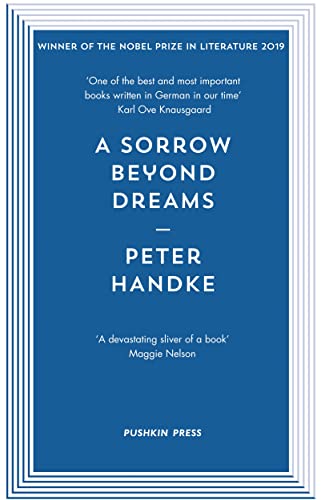
Handke said he avoided “poetic sentences” and “formulations,” because, as he put it, “isn’t all formulation, even of things that have really happened, more or less a fiction?” (“From this point on, he added in a parenthesis, I shall have to be careful to keep my story from telling itself.”) Yet he acknowledged that he was still producing “a literary work.” Knausgaard, too, had been fearing the same danger since the winter of 2008: the risk of unconsciously slipping into ready-made literature, into what Handke called a “ritual”—a form so comfortable for readers, we might add.
A clear opposition remains between the two writers. While Knausgaard suggests that his father may have committed a slow suicide, he views him solely in relation to himself. Not a word is said in the book about his father’s two divorces; in his narrative, this man is simply his father, period. Handke, by contrast, traces his ancestry back to his great-grandparents in his effort to understand the woman who lived in impoverished Slovenia, abandoned her innermost dreams, and gradually faded into the background.
*
“The Name and the Number” shows that you can do just about anything you want in a novel—even depart from it without ever really leaving. Throughout My Struggle, there are, in fact, many essayistic digressions, but each time Knausgaard returns to his central narrative. He argues that fiction, when unshackled from rigid expectations, can be more open, complex, and powerful than the essay. But what kind of fiction? All possible labels have been tried on My Struggle: autobiographical novel, family saga, true story. But there is no fabulation here, no invented characters, and the protagonist’s life mirrors the author’s own exactly. His “I” is stripped of literary artifice. Simple autobiography then? Hardly. The numerous essays scattered through the work belong to another register entirely. The narrative itself is only partly retrospective. It neither offers a cohesive life story nor seeks to cast the author in a flattering light, let alone to seduce the reader. Instead, it lingers on trivia, on moments that shaped nothing of consequence. Meta-novel, perhaps? In Scandinavia, some have called it a “performative biography” or “fiction without fiction.” Yet every category feels askew, with passages that stubbornly refuse to fit. Knausgaard seems to have changed the rules of the game.
Nor does My Struggle align with autofiction, where authors typically conceal themselves behind narrators, skillfully blending truth and fiction, refining the language, and pursuing aesthetic effect. Knausgaard operates on entirely different ground. He privileges the raw constraints of reality over genre conventions—though not without occasional slips. With him, the author has stepped out from behind the curtain, dismissed the narrator, and assumed direct control. He reduces inventions to a minimum, without depriving the story of a literary cachet, that flows from a narrative that nothing stops, unconcerned with tidying up every detail. Autofiction is like a set of scales, balancing the real and the fictional. Some use it for modesty, others to amplify their truth. Knausgaard’s novel is something else: he recounts only what he has lived and lays his emotions bare. Any “fictional” elements are largely utilitarian, dictated by external factors or memory defects.
Knausgaard did not observe himself from a distance through the lens of the traditional autobiographer, nor did he blur reality and fiction in the manner of autofiction. He has also rejected the irony and detachment of postmodernism—its intellectual “posturing”—in favor of a frank, unfiltered directness, at times presenting himself as naively guileless. In doing so, he may have dissolved the ambiguous artifice of autofiction, ushering in a new “post-autofiction” era, if we can risk the term. What is undeniable is that he has expanded the novel’s possibilities. It is no surprise, then, that his work has drawn such admiration—from Zadie Smith, who was captivated by his fusion of life and writing, to Rachel Cusk, who hailed it as a landmark in world literature, noting by that mirroring life’s unscripted course, Knausgaard shows that there is no “story,” and it is precisely through this refusal hat he achieves authenticity.

♠
All quotations from My Struggle are drawn from Don Bartlett’s and Martin Aitken’s outstanding translations, published by Penguin Books.
The excerpt from Peter Handke’s A Sorrow Beyond Dreams is taken from Ralph Manheim’s translation.
Readers of French can find excerpts from My Struggle at the end of the original article.
Additional Resources
- Toril Moi’s excellent lecture situates Knausgaard’s work within the context of contemporary literature. (Please note that the lecture begins in Norwegian but switches to English around the fourteen-minute mark.)
- The Fall 2020 issue of Scandinavian Studies, devoted to Knausgaard, provides an overview of how his novel has been read in Scandinavia and draws parallels with Coetzee, Ferrante, and Proust.
- Knausgaard’s lecture Inadvertent, published by Yale in 2018, summarizes his conception of literature, though it adds little for readers already familiar with Some Rain Must Fall.
- Knausgaard’s interviews with Joshua Rothman in The New Yorker and James Wood in The Paris Review.
- The joint interview with Maggie Nelson, author of The Argonauts, in which she and Knausgaard discuss their shared interests: attention to detail, reflections on children, the interplay of memory and creation, and their respective popularity.
 Jacques Desrosiers
 Quartiers littéraires